
Zero-Click Search: How to Survive the AI Apocalypse
Zero-click search is reshaping SEO. Learn how to survive AI Overviews, win citations, build demand and turn visibility into measurable growth.
7/14/202611 min read
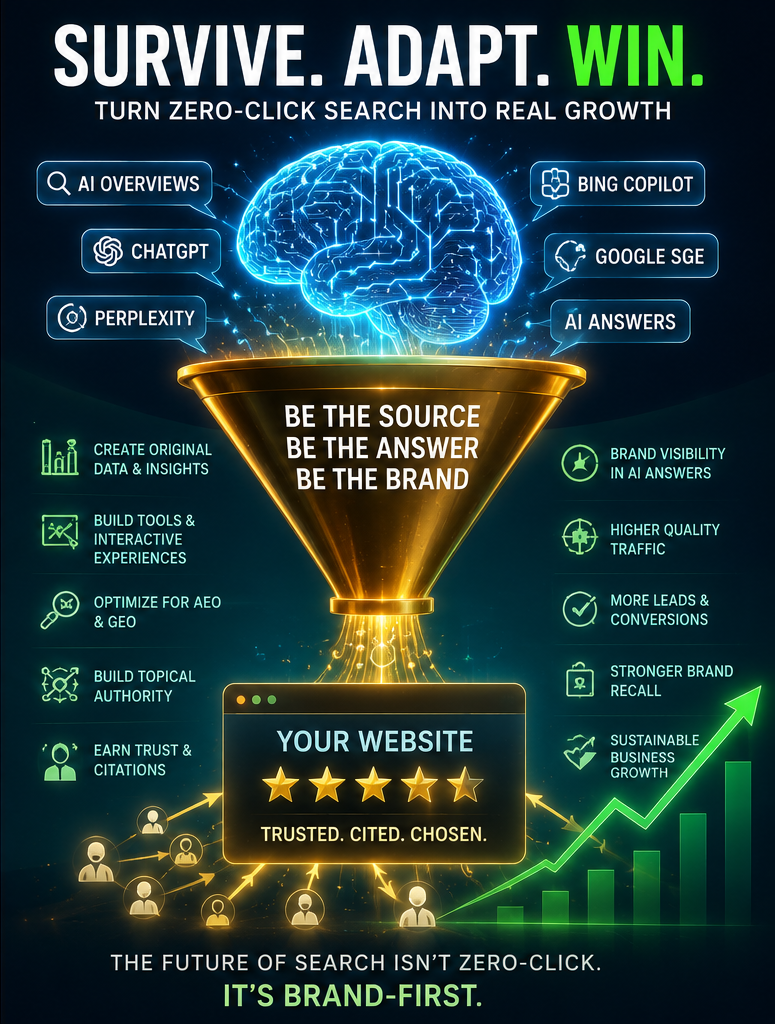
Surviving the “Zero-Click” AI Apocalypse: The New Rules of Search Visibility
For two decades, the deal was simple.
You created useful content. Google indexed it. A user searched. Your page ranked. The user clicked.
That click could become an email subscriber, a lead, an ad impression, an affiliate commission or a customer.
That deal is breaking.
Search engines and AI platforms increasingly answer questions before users ever reach the websites that supplied the information.
Google AI Overviews synthesize answers directly on the search results page. AI assistants can research, compare and explain topics in a single conversation. Search is evolving from a directory of links into an answer engine.
And that creates a brutal new reality for publishers, marketers and businesses:
You can rank. You can be cited. You can influence the answer. And you can still receive no click.
Welcome to the zero-click era.
The situation is serious, but calling it the death of SEO misses the larger transformation.
SEO is not disappearing. The unit of competition is changing.
The old objective was:
Rank → Click → Convert
The emerging objective is:
Be discovered → Be understood → Be cited → Be remembered → Be chosen
Businesses that continue optimizing only for blue-link rankings may watch impressions rise while clicks stagnate or fall.
Businesses that adapt can compete for something potentially more valuable than a single visit:
influence over the answer itself.
What Is Zero-Click Search?
A zero-click search occurs when a user gets enough information from the search interface that they do not click through to an external website.
Zero-click behaviour existed long before generative AI.
Google already answered many searches with:
Featured snippets
Knowledge panels
Local packs
Maps
Weather results
Calculators
Definitions
Sports scores
Shopping modules
Generative AI changes the scale of the problem.
Instead of extracting one short answer, AI systems can now synthesize information from multiple sources and produce:
Explanations
Comparisons
Recommendations
Buying guidance
Step-by-step instructions
Research summaries
Follow-up answers
The search engine is no longer merely helping the user find the answer.
Increasingly, it becomes the answer.
The Data Behind the Zero-Click Shift
The traffic threat is measurable.
A 2025 Pew Research Center analysis found that users who encountered a Google AI summary clicked a traditional search result in only 8% of visits, compared with 15% of visits when no AI summary appeared. Links inside the AI summaries themselves attracted clicks in only about 1% of visits.
Research from Ahrefs has also found substantial click losses associated with AI Overviews. Its updated 2026 analysis reported that the presence of an AI Overview was associated with a roughly 58% reduction in clicks to the top-ranking result in its study.
The disruption is not limited to conventional SEO studies. A 2026 causal study examining more than 161,000 matched Wikipedia article-language pairs estimated that exposure to Google AI Overviews reduced daily traffic to affected English-language articles by approximately 15%.
Meanwhile, a separate 2026 study of 11,500 real-user queries found AI Overviews on 51.5% of representative queries in its dataset and found substantial differences between the sources surfaced by traditional search and generative search.
The exact percentage will vary by query set, industry, geography and methodology.
But the direction is difficult to ignore:
More information is being consumed before the click.
Why the Old SEO Model Is Breaking
Traditional SEO was built around a predictable economic exchange.
A publisher created content.
A search engine crawled and indexed it.
The search engine sent traffic back.
The publisher monetized that attention.
AI introduces a different model.
An AI system may crawl content, extract information from it, synthesize that information into an answer and satisfy the user without sending meaningful traffic to the original publisher.
Cloudflare has attempted to quantify this imbalance through what it calls the crawl-to-refer ratio: how often an AI or search crawler accesses content compared with how much referral traffic the associated platform sends back.
Its data has shown enormous differences between platforms and has helped expose a growing tension at the heart of the AI web: content can be consumed by machines at a scale far greater than the human traffic returned to its creator.
This is the real zero-click problem.
It is not simply that rankings are disappearing.
It is that the relationship between visibility and traffic is becoming weaker.
The Most Dangerous SEO Metric in 2026: Rankings Without Attention
Imagine this scenario.
Your article ranks near the top of Google.
Your impressions increase.
Your average position looks healthy.
Your brand may even appear as a source in an AI-generated answer.
But organic sessions decline.
That is no longer a contradiction.
It is a predictable outcome of answer-first search.
This means marketers need to stop treating rankings as the final result.
A ranking is an opportunity for exposure.
It is not a business outcome.
The metrics that matter now include:
Organic clicks
Branded search demand
AI citation visibility
Assisted conversions
Direct traffic
Email list growth
Returning visitors
Qualified leads
Revenue influenced by organic discovery
The question is no longer simply:
“Where do we rank?”
It is:
“When our market searches, how much of the resulting attention and demand do we capture?”
The First Rule of Survival: Stop Creating Content That AI Can Replace in 30 Seconds
This is uncomfortable, but necessary.
If an AI system can completely satisfy the user by summarizing your article in three paragraphs, your content has a substitution problem.
Consider a generic article titled:
“What Is Email Marketing?”
An AI system can answer that immediately.
The user may have no reason to visit the source.
Now compare it with:
“We Analysed 147 B2B Email Campaigns: The 7 Follow-Up Patterns That Generated the Most Replies”
That page contains something fundamentally harder to replace:
original information.
The strategic difference is enormous.
Highly replaceable content includes:
Basic definitions
Generic “what is” articles
Simple summaries
Commodity listicles
Rewritten competitor content
Generic how-to instructions
Articles containing no original experience or evidence
Harder-to-replace content includes:
Original research
Proprietary data
Experiments
Case studies
First-hand testing
Expert interviews
Original frameworks
Calculators and tools
Templates
Benchmarks
Unique datasets
Strong analysis
Distinctive opinions backed by evidence
The future belongs to information gain.
If the top ten results say essentially the same thing, publishing an eleventh version is not a strategy.
Your page needs to contribute something the existing information environment does not already contain.
From SEO to AEO and GEO: Optimize for Retrieval, Not Just Rankings
The terminology is still evolving, but two concepts have become increasingly important:
AEO — Answer Engine Optimization
The practice of structuring information so answer systems can understand and surface it.
GEO — Generative Engine Optimization
The practice of increasing the likelihood that a brand, entity or source appears in AI-generated answers.
These disciplines do not replace SEO.
They expand it.
Traditional SEO asks:
How do we rank this page?
AI-era optimization asks:
How do we make our information easy to retrieve, trust, cite and associate with our brand?
That requires a different content architecture.
1. Build “Citation-Ready” Content
AI systems need extractable information.
Do not bury your strongest insight beneath 800 words of throat-clearing.
Create passages that can stand on their own.
A strong citation-ready section often contains:
Question → Direct answer → Evidence → Context
For example:
What Is Zero-Click Search?
Zero-click search occurs when a user completes a search without visiting an external result because the search interface itself provides enough information to satisfy the query. AI-generated answers accelerate this behaviour by synthesizing information from multiple sources directly inside the search experience.
That paragraph is:
Self-contained
Semantically clear
Direct
Easy to quote
Easy to summarize
Easy for a human to understand
Clarity is becoming a distribution advantage.
2. Create Original Data That AI Systems Need to Attribute
Commodity information can be synthesized from hundreds of sources.
Original evidence cannot.
Businesses should increasingly create proprietary assets such as:
Annual industry reports
Customer surveys
Pricing studies
Performance benchmarks
Original experiments
Market datasets
Before-and-after case studies
Instead of publishing:
“Best AI Marketing Tools”
publish:
“We Tested 25 AI Marketing Tools Across 100 Tasks: Here Are the Results”
Instead of:
“Average SEO Conversion Rate”
publish:
“SEO Conversion Benchmarks by Industry: Analysis of 500 Landing Pages”
The more your content becomes a primary source, the harder it becomes to replace you with a generic synthesis.
3. Build Tools, Not Just Articles
A user may not need to click an article to learn the formula for return on ad spend.
But they may click to calculate their own ROAS.
This distinction matters.
Static information is increasingly vulnerable to zero-click consumption.
Interactive utility is more defensible.
Examples include:
ROI calculators
Cost estimators
Comparison tools
Auditing tools
Templates
Generators
Checklists
Interactive assessments
Industry databases
A calculator does something an AI summary cannot fully replicate without collecting the user's inputs and performing the experience itself.
This is why the future of content marketing is not merely more content.
It is content plus utility.
4. Target Queries Where the Click Still Matters
Not every keyword has equal zero-click risk.
A query such as:
“What does SEO stand for?”
can be answered instantly.
A query such as:
“Best SEO agency for a dental clinic in Mumbai”
involves evaluation.
A query such as:
“SEO pricing calculator for a small business in India”
requires interaction.
A query such as:
“Vultus X SEO services”
is navigational and brand-driven.
This suggests a useful strategic framework.
High Zero-Click Risk
Definitions
Simple factual queries
Basic explanations
Short informational questions
Commodity knowledge
Medium Zero-Click Risk
Comparisons
Product research
Complex how-to searches
Troubleshooting
Strategic questions
Lower Zero-Click Risk
Transactional searches
Local searches
Tool-based searches
Branded searches
Service evaluation
High-consideration purchases
Queries requiring first-hand experience
SEO teams should therefore evaluate click potential, not merely search volume.
A keyword with 50,000 searches and almost no reason to click may be less valuable than a 2,000-search keyword with strong commercial intent.
5. Build a Brand People Search for by Name
This may be the most important long-term defence.
If someone searches:
“best AI SEO tools”
you compete with everyone.
If someone searches:
“Vultus X AI SEO tools”
you own the intent.
That is the difference between borrowed demand and branded demand.
Zero-click systems are strongest when the user does not care where the answer comes from.
Brand changes that.
A recognizable brand creates preference before the search result appears.
The objective should therefore be to increase:
Branded searches
Direct traffic
Brand mentions
Newsletter subscribers
Social recognition
Repeat visitors
Community participation
Word of mouth
This is where traditional SEO and classic brand strategy converge.
Every piece of content should contribute to a recognizable identity, not merely occupy another keyword position. The principle is old even if the distribution system is new: consistent communication compounds into brand image, while research and relevance matter more than superficial “creativity.”
6. Create a Recognizable Point of View
AI can summarize consensus exceptionally well.
That creates an opportunity for businesses willing to say something distinctive.
Consider these two statements:
Generic:
“AI is changing SEO, so businesses should adapt their strategies.”
Distinctive:
“The biggest SEO mistake of the AI era is optimizing for rankings while ignoring whether the searcher still has a reason to click.”
The second statement has an argument.
It gives the reader something to remember.
A strong content brand should develop:
Named frameworks
Repeatable principles
Clear positions
Original terminology
Recognizable editorial standards
This does not mean manufacturing controversy.
It means having something more useful to contribute than a summary of what everyone else already said.
7. Become an Entity, Not Just a Website
AI systems increasingly operate through relationships between:
People
Companies
Products
Topics
Locations
Publications
Expertise
Your goal is not merely to have pages indexed.
Your goal is to create a consistent digital identity that machines and humans can understand.
That means maintaining consistency across:
Your website
Author profiles
Organization information
Social profiles
Industry directories
Third-party mentions
Interviews
Podcasts
Research citations
Structured data
If the web repeatedly associates your brand with a specific area of expertise, that relationship becomes easier to understand.
For Vultus X, for example, the strategic objective should not simply be:
“Rank for AI marketing.”
It should be:
“Become repeatedly associated with practical AI marketing, SEO, automation and digital growth.”
That is a much larger game.
8. Stop Renting Your Entire Audience
Google traffic is rented.
Social reach is rented.
AI visibility is rented.
Algorithms can change the distribution terms at any time.
An email list is different.
A customer database is different.
A direct relationship is different.
Every high-value page should therefore have a clear mechanism for converting temporary attention into an owned relationship.
That could be:
A newsletter
A free tool
A downloadable template
An original report
A benchmark database
A consultation
A free audit
A useful email course
The goal is not to collect emails for the sake of collecting emails.
The goal is to create a reason for someone to return without needing to rediscover you through an algorithm.
9. Measure Share of Answer, Not Just Share of SERP
Rank tracking alone is becoming incomplete.
A modern visibility programme should ask:
Does our brand appear in AI answers?
Are our competitors mentioned more frequently?
Which pages are being cited?
For which topics are we treated as a source?
Is our brand described accurately?
Are AI citations producing qualified referral traffic?
Does AI exposure increase branded search?
This creates a new metric:
Share of Answer
Share of Answer measures how frequently your brand appears in relevant AI-generated responses across a defined set of commercially important prompts.
For example, a digital marketing agency could monitor prompts such as:
Best SEO agencies for small businesses in India
How to automate digital marketing
Best AI marketing tools
SEO agency for local businesses
How much should SEO cost in India
The objective is not to manipulate AI systems.
It is to understand whether your brand exists in the information environment from which customers increasingly make decisions.
10. Make Every Click Worth More
If organic clicks become harder to earn, conversion becomes more important.
The old model could tolerate waste:
100,000 visitors × 1% conversion rate = 1,000 conversions
A lower-traffic environment demands greater efficiency:
50,000 better-qualified visitors × 3% conversion rate = 1,500 conversions
Less traffic does not automatically mean less business.
The more important question is:
What is the commercial value of the traffic you still receive?
Improve:
Message match
Page speed
Calls to action
Internal linking
Lead magnets
Trust signals
Case studies
Conversion paths
Retargeting
Email nurturing
The goal is no longer traffic at any cost.
It is qualified attention converted efficiently.
The New Content Moat
The strongest defence against zero-click search can be summarized in one formula:
Originality × Utility × Authority × Brand
Originality
Publish information that does not already exist everywhere else.
Utility
Give users something they can use, calculate, compare, test or implement.
Authority
Demonstrate why your information deserves trust.
Brand
Make the source memorable enough that people seek it out again.
Weak content competes on keywords.
Strong content builds an information asset.
This echoes a fundamental principle from classic direct-response thinking: the market already contains powerful desires, problems and motivations. The marketer's job is not to invent demand from nothing but to understand it and channel it toward a credible solution.
The technology has changed.
Human motivation has not.
A Practical 90-Day Zero-Click Survival Plan
The transition does not require abandoning your existing SEO programme.
It requires upgrading it.
Days 1–30: Audit Your Exposure
Identify:
Pages losing clicks despite stable rankings
Keywords triggering AI answers
High-impression, low-CTR pages
Generic content vulnerable to summarization
Pages generating conversions rather than vanity traffic
Topics where competitors dominate AI citations
Classify every important content asset as:
Defend, Upgrade, Consolidate or Retire.
Days 31–60: Build Defensible Assets
Create:
One original research asset
One interactive tool
One proprietary framework
Three expert-led articles
One detailed case study
Update existing pages with:
Direct answers
Original insights
Better sourcing
First-hand evidence
Clear author information
Stronger internal links
Days 61–90: Build Demand Beyond Search
Launch a repeatable distribution system across:
Email
Social media
Industry communities
Digital PR
Partnerships
Expert contributions
Track:
Branded search growth
Direct traffic
AI citations
Email subscribers
Qualified leads
Assisted conversions
Do not ask only:
“Did traffic increase?”
Ask:
“Did our influence over the market increase?”
Should You Block AI Crawlers?
There is no universal answer.
Some publishers may decide that allowing unrestricted AI crawling provides too little value.
Others may prioritize visibility inside AI systems.
Cloudflare has already introduced tools designed to give content owners greater control, including mechanisms for blocking AI crawlers and experimenting with pay-per-crawl access.
The correct decision depends on your business model.
A publisher dependent on page views may think differently from a consultancy whose primary objective is being discovered by prospective clients.
Ask:
Does AI visibility generate brand value?
Are citations producing meaningful referrals?
Is the content commercially sensitive?
Does the business depend on advertising impressions?
Could restricting access reduce future discoverability?
Treat crawler access as a strategic business decision, not merely a technical SEO checkbox.
The Real Opportunity Hidden Inside the “Apocalypse”
Every major change in search destroys some advantages and creates others.
The keyword-stuffing era rewarded scale.
The backlink era rewarded authority.
The content era rewarded publishing.
The AI era will increasingly reward source value.
The businesses most vulnerable are those that built their entire growth model on producing interchangeable information and receiving predictable search traffic in return.
The businesses with the strongest position will be those that become:
Original sources
Recognized experts
Useful tools
Trusted brands
Direct destinations
The future of search may contain fewer clicks.
But the clicks that remain may carry stronger intent.
And the brands that become trusted inputs to AI-generated answers may influence customers long before a website visit ever occurs.
Final Takeaway: Don't Fight Zero-Click Search. Become Impossible to Replace.
The zero-click AI apocalypse is real enough to demand action.
But panic is not a strategy.
The winning response is not to publish more generic content.
It is to become more valuable.
Create information worth citing.
Build tools worth visiting.
Publish evidence worth referencing.
Develop opinions worth remembering.
Create a brand worth searching for directly.
Because in the old internet, winning meant being the best result.
In the AI internet, winning means becoming part of the answer — and giving people a reason to seek out the source.
If your business is still measuring SEO success purely through rankings and traffic, the measurement system is already behind the market.
Vultus X helps businesses build search strategies for the next generation of discovery — combining technical SEO, high-authority content, AI visibility and conversion strategy to turn changing search behaviour into measurable growth.
The apocalypse is optional.
Adaptation isn't.
Contact
VultusX is a results-driven digital marketing company helping businesses grow online through SEO, content marketing, paid advertising, and performance-driven strategies.
If you’re looking for reliable digital marketing services that focus on measurable results, transparency, and long-term growth, our team is here to help.
📩 Get in touch to discuss how VultusX can support your business goals with smart, scalable digital marketing solutions.
Phone
info@vultusx.com
+919226268106
© 2026. All rights reserved.
Phone