
How to Rank in ChatGPT Search: The Definitive Guide (2026)
Learn how to rank in ChatGPT Search with proven strategies covering AI SEO, entity optimization, EEAT, technical SEO, and AI citations.
7/16/202616 min read
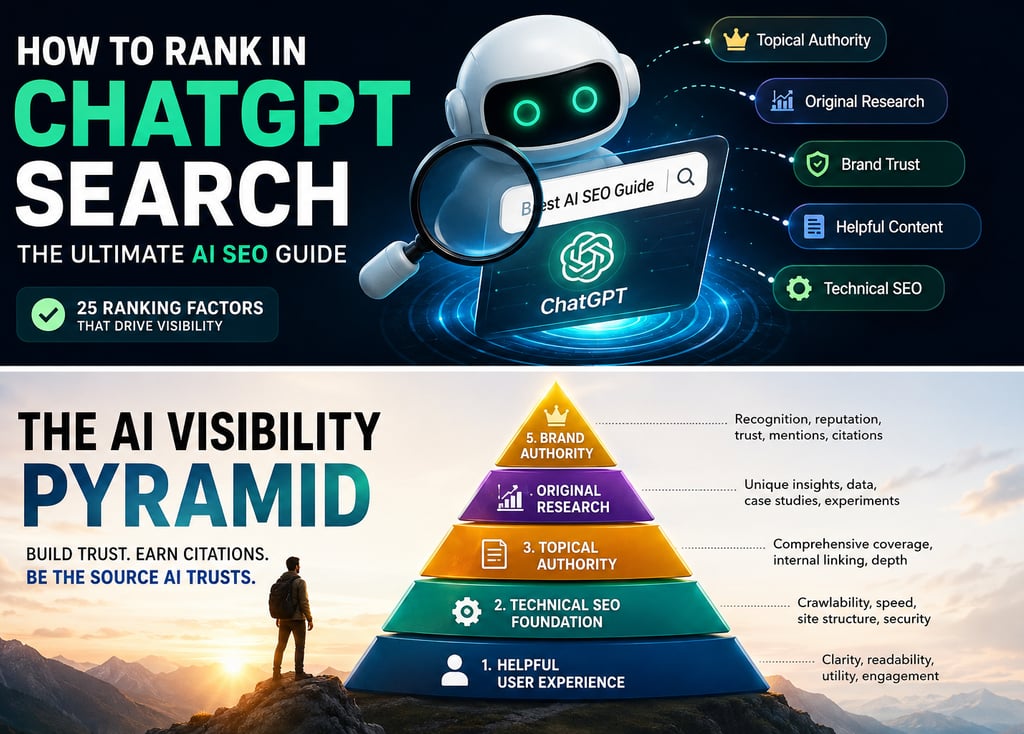
How to Rank in ChatGPT Search: The Definitive Guide (2026)
Artificial intelligence is changing how people search for information.
For more than two decades, Google dominated search by presenting users with a list of web pages ranked according to relevance and authority. Businesses competed for clicks by improving their SEO, building backlinks, and creating high-quality content.
Today, a growing number of users begin their search somewhere different.
Instead of typing queries into Google, they ask ChatGPT.
Questions like:
What's the best CRM for a small business?
How do I start a digital marketing agency?
Best AI SEO tools for agencies
Compare Semrush vs Ahrefs
Rather than receiving ten blue links, users receive a complete, conversational answer—often with citations to trusted websites.
This shift represents one of the biggest changes in search since Google launched.
For businesses, publishers, and marketers, the question is no longer just "How do I rank on Google?"
The new question is:
How do I become one of the sources ChatGPT trusts enough to reference?
That's exactly what this guide will teach you.
Unlike many articles that rely on speculation, this guide combines SEO best practices, OpenAI guidance, search engine principles, and practical AI optimization strategies to help your content become more discoverable in ChatGPT Search.
Table of Contents
What Is ChatGPT Search?
How ChatGPT Search Works
Can You Really Rank in ChatGPT?
How ChatGPT Chooses Websites
Why Traditional SEO Is No Longer Enough
What Is ChatGPT Search?
ChatGPT Search is OpenAI's AI-powered search experience that combines a conversational language model with real-time information from the web.
Instead of showing a page of links, ChatGPT can:
Answer complex questions
Summarize multiple sources
Compare products
Explain technical concepts
Recommend businesses and tools
Cite relevant websites
Continue the conversation with follow-up questions
For users, this creates a faster and more natural search experience.
For businesses, it changes how visibility is earned.
Rather than competing only for Google's first page, websites increasingly compete to become trusted sources that AI systems reference when generating answers.
This doesn't mean Google is becoming irrelevant. In fact, the fundamentals of technical SEO, high-quality content, and authority remain essential. The difference is that AI systems evaluate content in ways that prioritize clarity, trustworthiness, topical depth, and usefulness.
How ChatGPT Search Works
Many people assume ChatGPT has its own independent search engine.
It doesn't.
When appropriate, ChatGPT can retrieve fresh information from the web using search partners and then synthesize that information into a conversational response. Instead of copying one webpage, it analyzes multiple trusted sources, extracts relevant facts, and presents them in a readable format while providing citations where applicable.
A simplified workflow looks like this:
User Query → Search Retrieval → AI Analysis → Source Evaluation → Response Generation → Citations
During this process, several factors influence which websites are used:
Relevance to the query
Topical authority
Freshness of information
Overall trustworthiness
Clarity of the content
Reputation of the source
Notice something important.
The AI is not simply asking:
"Which page ranks #1?"
It's asking:
"Which sources best help me answer this question accurately?"
That distinction changes content strategy completely.
Can You Really Rank in ChatGPT Search?
The answer is both yes and no.
Unlike Google, ChatGPT doesn't display a fixed list of ten ranked results.
Instead, it dynamically generates responses based on the user's question and the information it retrieves.
So technically, there is no "#1 ranking" in the traditional SEO sense.
However, websites can consistently appear as:
Referenced sources
Recommended businesses
Supporting citations
Suggested tools
Trusted authorities
From a marketing perspective, this is effectively what "ranking" means in ChatGPT.
Your goal is to maximize the probability that your website becomes one of the sources selected to help answer relevant questions.
Think of it this way:
Traditional Google SEO
Keyword → Ranking → Click → Conversion
ChatGPT Search
Question → AI Retrieval → Citation → Trust → Click → Conversion
The end goal remains the same—earning qualified traffic and customers—but the path has evolved.
How ChatGPT Chooses Websites
One of the biggest misconceptions is that ChatGPT randomly selects websites.
It doesn't.
While the exact weighting of its retrieval systems isn't publicly disclosed, the sources it surfaces consistently exhibit several characteristics.
1. High Topical Authority
AI systems favor websites that demonstrate deep expertise in a subject rather than publishing a handful of unrelated articles.
For example, a site with 100 high-quality articles on SEO is generally a stronger authority than a general blog with one SEO article among hundreds of unrelated posts.
This is why topical clusters matter.
Instead of writing isolated posts, build comprehensive content ecosystems around a core subject.
2. Clear, Structured Content
AI models understand well-organized information more effectively than cluttered pages.
Use:
Descriptive headings
Short paragraphs
Bullet lists
Tables
Definitions
FAQs
Clear structure helps both humans and AI systems locate important information quickly.
3. Original Insights
If your article simply repeats what every competitor already says, there's little reason for an AI system to prefer it.
The strongest content includes:
Original research
Proprietary frameworks
Case studies
Data analysis
First-hand experience
Expert commentary
Originality makes your content more valuable and more likely to be cited.
4. Trust Signals
Trust has become one of the most important ranking factors in AI-powered search.
Strong trust signals include:
Author biographies
Company information
Transparent sourcing
Updated content
Positive brand reputation
Consistent publishing
These align closely with Google's emphasis on Experience, Expertise, Authoritativeness, and Trust (EEAT), reinforcing that quality signals matter across both traditional and AI search.
5. Strong Brand Recognition
Increasingly, AI systems don't just recognize pages—they recognize brands.
A company consistently associated with SEO through high-quality content, research, tools, and industry mentions is more likely to be viewed as an authoritative source than a site with little external recognition.
This means branding is no longer separate from SEO.
Brand authority directly supports AI visibility.
Why Traditional SEO Isn't Enough Anymore
Traditional SEO focused heavily on rankings.
The assumption was simple:
Higher rankings generate more clicks.
While rankings still matter, AI-powered search introduces a new challenge.
Users can receive detailed answers without ever visiting a website.
This is often referred to as zero-click search.
The implication is profound.
Ranking highly is no longer enough if users never need to click.
The businesses that thrive in this environment will create content that offers value beyond a simple answer.
Examples include:
Interactive calculators
Original research
Downloadable templates
Detailed case studies
Industry benchmarks
Proprietary frameworks
These assets encourage users to visit the source because the AI summary cannot fully replace the experience.
This is where SEO, Answer Engine Optimization (AEO), and Generative Engine Optimization (GEO) converge.
Instead of asking:
"How do I rank higher?"
The better question is:
"How do I become the most trusted source on this topic?"
That mindset shift is the foundation of successful ChatGPT optimization.
Key Takeaways
The rise of ChatGPT Search doesn't signal the end of SEO—it signals its evolution.
Businesses that continue relying solely on keyword rankings will struggle as AI-generated answers become more common.
The winners will be organizations that build topical authority, publish genuinely useful content, establish recognizable brands, and create information worthy of citation.
In the next section, we'll explore the technical, content, and authority factors that increase your chances of being surfaced in ChatGPT Search, including practical strategies you can implement immediately to improve AI visibility.
25 Ranking Factors That Influence ChatGPT Search Visibility
There is no official document from OpenAI listing "ChatGPT ranking factors" the way Google publishes guidance for Search.
However, by analyzing how ChatGPT retrieves information, studying Google's Search quality guidelines, observing AI search behavior, and examining the characteristics of websites that are consistently cited, we can identify the factors that make a website significantly more likely to appear in AI-generated answers.
Think of these as AI Visibility Signals rather than traditional ranking factors.
Some carry more weight than others, but together they create a strong foundation for AI discoverability.
Technical AI SEO Signals
Without solid technical SEO, even outstanding content may never become eligible for retrieval.
1. Crawlability
If AI search systems can't crawl your website, they can't understand it.
Ensure:
Robots.txt isn't blocking important pages
Pages return a 200 status code
Internal links are accessible
JavaScript doesn't hide critical content
Navigation is crawl-friendly
Think of crawlability as the foundation of AI visibility.
2. Fast Loading Pages
Users expect AI answers instantly.
Slow websites create poor user experiences and often indicate underlying technical issues.
Aim for:
Core Web Vitals in the green
Image optimization
Lazy loading
CDN implementation
Efficient caching
Fast websites improve both SEO and user satisfaction.
3. HTTPS Security
Every important page should use HTTPS.
Secure websites are a basic trust signal and should be considered mandatory.
4. Clean Site Architecture
Imagine trying to understand a library where books are randomly scattered across the floor.
That's what a poorly organized website looks like to search systems.
Your structure should resemble:
SEO │ ├── Technical SEO ├── Local SEO ├── AI SEO ├── Link Building ├── Keyword Research
Logical architecture strengthens topical understanding.
5. XML Sitemap
Your sitemap helps search engines discover new pages quickly.
Whenever major content is published, ensure your sitemap updates automatically.
Content Quality Signals
This is where AI search differs most from traditional keyword-focused SEO.
AI systems reward content that genuinely helps answer questions.
6. Topical Authority
Publishing one article on AI SEO won't make you an authority.
Publishing:
AI SEO Guide
ChatGPT SEO
Google AI Mode
Entity SEO
Semantic SEO
AI Overviews
AI Ranking Factors
Zero Click Search
creates a knowledge hub.
Google and AI systems increasingly evaluate websites as topic experts rather than isolated pages.
7. Information Gain
One of the biggest mistakes in AI content is repeating what everyone else already says.
Ask yourself:
"What new information does this article contribute?"
Examples include:
Original research
Case studies
Frameworks
Industry surveys
Benchmarks
Experiments
Information gain makes your content more likely to be referenced instead of summarized away.
8. Search Intent Alignment
The best article isn't always the longest.
It's the one that satisfies user intent.
For example:
Query:
"How to Rank in ChatGPT Search"
The user wants:
Practical strategies
Actionable advice
Examples
Frameworks
Not 800 words explaining what ChatGPT is.
Always answer the user's question first.
9. Comprehensive Coverage
Cover the topic completely.
A definitive guide should answer:
What
Why
How
When
Examples
Mistakes
Best Practices
FAQs
Comprehensive coverage reduces the need for users to search elsewhere.
10. Freshness
AI evolves rapidly.
Articles from 2023 discussing early AI search may already be outdated.
Update cornerstone content regularly by:
Refreshing statistics
Adding new features
Updating screenshots
Revising recommendations
Fresh content signals ongoing expertise.
11. Clear Definitions
Whenever introducing a new concept, define it immediately.
Example:
Entity SEO is the practice of optimizing your website so search engines understand the people, places, organizations, and concepts your content discusses.
Simple definitions improve readability and retrieval.
12. Structured Formatting
Well-structured articles are easier for humans and AI systems to understand.
Use:
H2 headings
H3 headings
Numbered lists
Bullet points
Tables
Comparison charts
Short paragraphs
Structure improves comprehension.
Authority Signals
Authority isn't built overnight.
It's earned through consistency, expertise, and recognition.
13. EEAT
Google emphasizes:
Experience
Expertise
Authoritativeness
Trustworthiness
These principles remain valuable for AI search because trustworthy content is more useful for generating accurate answers.
Show:
Author credentials
Real-world experience
Transparent sourcing
Updated information
14. Brand Mentions
AI systems don't only understand websites.
They understand brands.
Mentions across:
News websites
Podcasts
Industry blogs
LinkedIn
Conferences
help establish credibility.
15. High-Quality Backlinks
Backlinks remain an important indicator of authority.
Focus on earning links from:
Universities
Industry publications
Government resources
Trusted businesses
Original research citations
Quality always outweighs quantity.
16. Author Reputation
People increasingly follow experts rather than anonymous websites.
Build visible author profiles that include:
Biography
Expertise
Social profiles
Previous work
Credentials
Authority compounds over time.
17. Original Research
Nothing separates your content from competitors like publishing data no one else has.
Examples:
AI SEO surveys
Ranking studies
Industry benchmarks
Marketing experiments
Original research often attracts backlinks, citations, and AI references.
Entity SEO Signals
Entity SEO is becoming one of the most important areas of modern optimization.
18. Consistent Brand Identity
Ensure your:
Company name
Logo
About page
Contact details
Social profiles
are consistent across the web.
Consistency reduces ambiguity.
19. Semantic Relationships
Instead of stuffing keywords, build relationships between concepts.
For example, an article about ChatGPT Search naturally relates to:
AI Search
Google AI Mode
Large Language Models
Entity SEO
Semantic Search
EEAT
Information Retrieval
This creates a richer topical network.
20. Internal Linking
Every article should support your pillar content.
For example:
AI SEO Guide
↓
ChatGPT Search
↓
Zero Click Search
↓
Entity SEO
↓
Semantic SEO
↓
AI Ranking Factors
Strong internal linking helps search systems understand your site's expertise.
User Experience Signals
AI systems ultimately serve people.
Better experiences create stronger long-term signals.
21. Readability
Avoid unnecessary jargon.
Use:
Short paragraphs
Simple language
Visual hierarchy
Examples
Good writing increases engagement.
22. Helpful Media
Images, charts, diagrams, and infographics improve understanding.
Rather than decorating content, visuals should explain concepts.
Examples:
AI retrieval workflow
Entity relationship diagrams
SEO vs AI Search comparison tables
23. Interactive Elements
Static articles increasingly compete with AI summaries.
Interactive experiences cannot be summarized as easily.
Examples:
AI SEO audits
ROI calculators
Prompt generators
Checklists
Assessment tools
Utility creates a compelling reason to visit your website.
Commercial Signals
Visibility is valuable only when it contributes to business goals.
24. Clear Calls to Action
After educating readers, guide them toward the next logical step.
Examples include:
Download a checklist
Try a free tool
Request an audit
Subscribe to a newsletter
Book a consultation
A well-placed CTA converts attention into opportunity.
25. Strong Brand Recall
The best outcome isn't simply earning one click.
It's becoming memorable.
If readers later search specifically for your brand because they trust your expertise, you've moved beyond competing for generic keywords.
That kind of brand recognition compounds over time and strengthens both traditional SEO and AI visibility.
The AI Visibility Pyramid
The 25 factors can be simplified into a five-layer framework:
AI Visibility Pyramid
5. Brand Authority
↓
4. Original Research
↓
3. Topical Authority
↓
2. Technical SEO
↓
1. User Experience
The higher you climb, the harder it becomes for competitors to replicate your advantage.
Key Takeaways
There is no single trick that guarantees visibility in ChatGPT Search.
Instead, success comes from combining technical excellence, comprehensive content, topical authority, entity optimization, and genuine trust.
Businesses chasing shortcuts or publishing hundreds of thin AI-generated articles may achieve temporary visibility, but long-term success belongs to brands that consistently produce useful, original, and authoritative content.
Google SEO vs. ChatGPT Search: What's the Difference?
One of the biggest misconceptions in AI search is that Google SEO and ChatGPT Search Optimization are completely different disciplines.
They're not.
In fact, around 80% of traditional SEO best practices still apply. The difference lies in how information is retrieved, synthesized, and presented.
Instead of optimizing solely for rankings, you're optimizing for AI retrieval, citations, and trust.
Traditional Google SEO vs. ChatGPT Search Optimization
Traditional Google SEO
Focuses on achieving higher rankings in search results.
Primarily optimizes for keywords and search intent.
Success is measured by organic traffic and clicks.
Backlinks remain one of the strongest authority signals.
The goal is to rank on the first page of Google.
Users typically search one question at a time.
ChatGPT Search Optimization
Focuses on becoming a trusted source that AI can cite.
Optimizes around topics, entities, and expertise instead of just keywords.
Success is measured through AI visibility, citations, brand mentions, and qualified traffic.
Brand authority, trust, and content credibility become increasingly important.
The goal is to become part of the AI-generated answer.
Search is conversational, allowing users to ask follow-up questions naturally.
The Bottom Line
Traditional SEO is about getting users to click your website.
ChatGPT Search Optimization is about becoming a trusted source that AI recommends.
The businesses that succeed in the future will do both.
The takeaway is simple:
Good SEO is still good AI SEO—but exceptional AI SEO requires authority, originality, and trust.
10 Common Mistakes Preventing Websites from Appearing in ChatGPT Search
Many businesses assume AI search requires an entirely new strategy. In reality, most failures stem from ignoring SEO fundamentals.
1. Publishing Generic AI Content
AI-generated articles that simply paraphrase existing content rarely provide unique value.
If your article says exactly what 100 others already say, why should ChatGPT reference yours?
Always ask:
"What new insight am I contributing?"
2. Ignoring Topical Authority
Publishing one article about SEO doesn't make you an SEO authority.
Publishing 100 interconnected articles does.
Become known for one subject before expanding into another.
3. Chasing Keywords Instead of Solving Problems
Modern search is intent-driven.
Instead of asking:
"Which keyword has the highest search volume?"
Ask:
"What problem is my audience trying to solve?"
Great content answers questions.
Exceptional content solves problems.
4. Weak Internal Linking
Every article should strengthen your knowledge ecosystem.
For example:
AI Search Optimization Guide
↓
How to Rank in ChatGPT Search
↓
Entity SEO
↓
Semantic SEO
↓
Zero-Click Search
↓
Google AI Mode
Internal links help both users and AI systems understand your expertise.
5. No Author Identity
Anonymous content struggles to build trust.
Every important article should clearly identify:
Author
Expertise
Experience
Company
Contact information
Trust is becoming one of the strongest competitive advantages.
6. Poor Content Structure
Walls of text are difficult for both users and AI systems.
Break content into:
Headings
Lists
Tables
FAQs
Definitions
Readable content performs better.
7. No Original Research
Original data is one of the fastest ways to earn backlinks, citations, and AI references.
Consider publishing:
Annual industry reports
Survey results
Case studies
Ranking studies
Marketing experiments
Become a source—not just another publisher.
8. Forgetting About Branding
People don't remember websites.
They remember brands.
Every article should reinforce:
Your expertise
Your values
Your unique perspective
Brand authority compounds over time.
9. Neglecting Technical SEO
Broken pages, slow websites, and poor crawlability limit discoverability.
Before publishing new content, ensure your technical foundation is solid.
10. Expecting Instant Results
Authority isn't built in weeks.
It's built through consistent publishing, continual improvement, and earning trust over time.
AI search rewards long-term investment.
How to Measure ChatGPT Search Visibility
Unlike Google rankings, ChatGPT visibility isn't represented by a single position.
Instead, monitor multiple indicators.
Organic Traffic
Monitor:
Organic sessions
Organic conversions
Landing pages
Returning visitors
Growing traffic remains a positive signal.
Referral Traffic
Monitor traffic arriving from AI platforms.
Look for referrals from:
ChatGPT
Bing
Microsoft Copilot
Perplexity
Other AI search experiences
These referrals help you understand whether AI systems are introducing users to your content.
Brand Searches
An increase in searches for your company name often indicates growing awareness.
Examples:
Vultus X
Vultus X SEO
Vultus X AI Marketing
Brand demand is one of the strongest indicators of long-term authority.
AI Citation Monitoring
Regularly test prompts such as:
Best AI SEO agencies
Best AI marketing blogs
How to Rank in ChatGPT Search
Track:
Whether your website appears
Which pages are cited
Which competitors appear
What topics generate mentions
This provides valuable insight into your AI visibility.
Assisted Conversions
Not every visitor converts immediately.
Someone may:
Read your article today →
Return through Google next week →
Book a consultation a month later.
Measure assisted conversions alongside direct conversions to better understand SEO's long-term impact.
The Future of ChatGPT Search
AI search is still evolving.
Over the next few years, expect major developments in:
Personalized Search
Responses will increasingly reflect user preferences, context, and previous interactions.
AI Agents
Instead of answering questions, AI systems will increasingly complete tasks such as:
Booking appointments
Comparing software
Purchasing products
Planning travel
Researching vendors
Businesses will compete to become trusted sources for these AI agents.
Multimodal Search
Search won't be limited to text.
Users will search using:
Images
Voice
Video
Documents
Screenshots
Optimizing across multiple formats will become increasingly important.
Entity-Based Search
Rather than matching keywords, AI systems will better understand relationships between:
People
Companies
Products
Services
Locations
Concepts
Building a recognizable digital entity will become a significant competitive advantage.
ChatGPT Search Optimization Checklist
Before publishing any important page, ask yourself:
✅ Is the content original?
✅ Does it solve a real problem?
✅ Is it technically crawlable?
✅ Does it demonstrate expertise?
✅ Is the information current?
✅ Does it include clear headings?
✅ Have I cited trustworthy sources?
✅ Is it internally linked?
✅ Does it strengthen my topical authority?
✅ Does it reinforce my brand?
If you answered "yes" to every question, your content is well positioned for both traditional SEO and AI-powered search.
Frequently Asked Questions
Does ChatGPT use Google Search?
No. ChatGPT uses its own retrieval systems and search partnerships rather than relying on Google's search results directly.
Can ChatGPT crawl my website?
Yes, provided your website allows appropriate crawling and isn't blocked by technical restrictions.
Does ChatGPT use backlinks?
Backlinks remain an important indicator of authority because they help establish trust and reputation, although AI retrieval considers many additional signals.
Is AI SEO replacing traditional SEO?
No.
AI SEO builds upon traditional SEO rather than replacing it.
The strongest AI strategies still rely on technical SEO, high-quality content, and topical authority.
How long does it take to appear in ChatGPT Search?
There is no fixed timeline.
Visibility depends on factors such as crawlability, authority, freshness, topical expertise, and the relevance of your content to users' questions.
Final Thoughts
The question isn't whether ChatGPT Search will influence SEO.
It already has.
The real question is whether your business will adapt before your competitors do.
Businesses that continue producing generic, keyword-focused content may find themselves losing visibility as AI-generated answers become increasingly comprehensive.
The businesses that succeed will be those that become trusted knowledge sources.
That means investing in:
Technical excellence
Original research
Topical authority
Strong branding
Helpful content
User trust
In other words, the future belongs to businesses that deserve to be cited—not just ranked.
Remember this simple principle:
Google ranks pages.
ChatGPT recommends trusted sources.
Your goal isn't simply to rank higher.
It's to become the source AI trusts when answering the questions your customers ask every day.
The Vultus X Framework: How to Become a Trusted Source in ChatGPT Search
Ranking in ChatGPT Search isn't about finding a secret algorithm or exploiting a loophole.
It's about becoming the most trustworthy and useful source on a topic.
At Vultus X, we use a simple framework that summarizes everything we've discussed so far.
The AI Visibility Framework
The journey to becoming a trusted AI source follows five stages:
Technical SEO → Content Authority → Entity Building → Brand Authority → AI Citations
Miss one of these stages, and your visibility weakens.
Master all five, and your chances of being referenced by AI systems increase significantly.
Let's break down each stage.
Stage 1: Build a Strong Technical Foundation
Before AI can recommend your website, it must first be able to discover and understand it.
Your technical SEO should include:
Fast page loading speeds
Mobile-friendly design
HTTPS security
XML sitemaps
Clean URL structures
Proper heading hierarchy
Internal linking
Crawlable pages
Optimized Core Web Vitals
Think of technical SEO as building the foundation of a house.
No matter how beautiful the house is, a weak foundation will eventually cause problems.
Stage 2: Create Content Worth Referencing
Most websites publish content.
Very few publish content that deserves to be cited.
Ask yourself:
"Would another expert reference this article?"
If the answer is no, AI probably won't either.
Great AI-friendly content should include:
Original research
Practical examples
Unique frameworks
Statistics
Real-world experience
Step-by-step processes
Updated information
The goal isn't simply to answer questions.
The goal is to answer them better than everyone else.
Stage 3: Become an Authority on One Topic
One excellent article won't make you an authority.
Neither will ten unrelated blog posts.
Authority comes from topical depth.
Imagine your website is about AI marketing.
Instead of publishing random content, create an ecosystem like this:
AI Search Optimization
ChatGPT Search
Google AI Mode
AI Overviews
Entity SEO
Semantic SEO
AI Marketing Tools
AI Automation
AI Content Marketing
AI Analytics
Every article strengthens the others.
Over time, search engines and AI systems begin associating your brand with that subject.
This is called Topical Authority, and it's one of the strongest long-term SEO advantages you can build.
Stage 4: Build a Recognizable Brand
One of the biggest differences between traditional search and AI search is the importance of brand recognition.
Google ranks pages.
AI recommends brands it trusts.
Ask yourself:
Does my business have a clear identity?
Do people mention my brand online?
Have I published original insights?
Have I appeared on reputable websites?
Do I have customer reviews?
Am I building thought leadership?
Every positive mention strengthens your digital reputation.
Over time, these signals compound into brand authority.
Stage 5: Earn AI Citations
Everything you've done so far leads to this final stage.
The goal isn't simply to appear in search results.
It's to become one of the sources AI systems reference when answering questions.
The best way to earn citations is by publishing content that is:
Accurate
Comprehensive
Well-structured
Original
Up to date
Trustworthy
Easy to understand
AI systems are designed to reduce uncertainty.
The more confidence they have in your content, the more likely they are to use it.
Why Original Research Is Your Biggest Competitive Advantage
The internet already contains millions of articles explaining SEO.
Writing another one won't make you stand out.
Instead, create information that doesn't exist anywhere else.
Examples include:
Survey 500 marketers and publish the results.
Analyze 1,000 websites and identify ranking trends.
Compare AI search platforms using real-world testing.
Publish annual benchmark reports.
Document experiments and share the outcomes.
Original research turns your website into a primary source rather than another opinion.
That's exactly the type of content journalists, bloggers, and AI systems want to reference.
Build Tools, Not Just Articles
One of the smartest ways to survive the AI search era is to create resources that can't easily be summarized.
Instead of writing another article, consider building:
ROI Calculators
SEO Audit Tools
AI Prompt Generators
Marketing Budget Calculators
Keyword Difficulty Checklists
AI Readiness Assessments
Local SEO Scorecards
Content Brief Generators
Tools create interaction.
Interaction creates engagement.
Engagement builds trust.
Trust leads to citations.
Think Like a Publisher, Not Just an SEO
The websites that dominate AI search won't necessarily publish the most content.
They'll publish the most useful content.
Instead of asking:
"How many articles should we publish this month?"
Ask:
"What resources would become indispensable to our audience?"
That shift changes everything.
Rather than chasing keywords, you'll begin creating assets that generate links, mentions, shares, and citations naturally.
The 2026 AI Search Success Formula
If you remember only one thing from this guide, remember this:
Helpful Content + Technical SEO + Topical Authority + Brand Trust + Original Research = AI Search Visibility
Every successful AI search strategy is built on these five pillars.
There are no shortcuts.
No secret prompts.
No hidden ranking hacks.
The businesses that consistently educate, innovate, and provide genuine value will be the ones AI systems trust the most.
Key Takeaway
ChatGPT Search isn't rewarding websites that simply publish more content.
It's rewarding websites that publish better content.
If your goal is long-term organic growth, stop trying to outwrite the internet.
Start trying to outteach it.
Because in the AI era, the winners won't be the loudest publishers.
They'll be the most trusted educators.
Ready to Optimize for AI Search?
At Vultus X, we help businesses move beyond traditional SEO by building strategies designed for the future of search. From technical SEO and content strategy to entity optimization, AI visibility, and authority building, we help brands become trusted sources in an AI-first world.
The future of search has already arrived.
The best time to optimize for it is today.
Contact
VultusX is a results-driven digital marketing company helping businesses grow online through SEO, content marketing, paid advertising, and performance-driven strategies.
If you’re looking for reliable digital marketing services that focus on measurable results, transparency, and long-term growth, our team is here to help.
📩 Get in touch to discuss how VultusX can support your business goals with smart, scalable digital marketing solutions.
Phone
info@vultusx.com
+919226268106
© 2026. All rights reserved.
Phone